



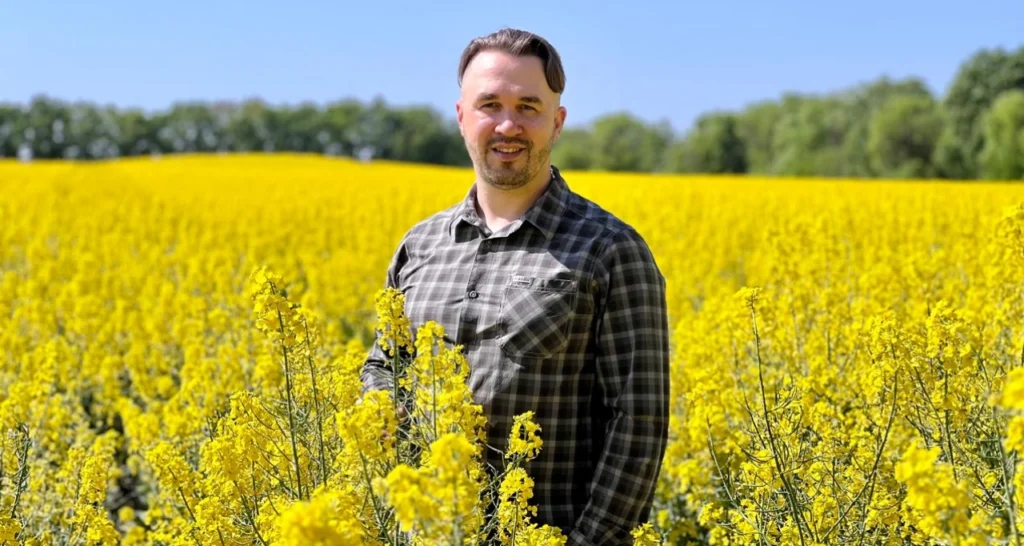
The USAID AGRO Activity contributed to the development of legislative changes for implementing land reform. Farm owners gained new opportunities to strengthen their businesses.
“I am one of those farmers who have always supported the idea of a land market,” begins Roman Horobets, director and co-owner of ASTRA Farm in the Poltava region. His company cultivates just over 2,000 hectares of land, growing soybeans, barley, corn, sunflowers, wheat, and rapeseed.
ASTRA Farm is a prime example of a family farming business: the parents founded it from scratch 25 years ago, and now their children continue the agricultural work. Thanks to the land reform implemented in Ukraine with the support of the USAID AGRO Activity, ASTRA Farm gained new opportunities for development and strengthening the farm.
“In the early 2000s, provisions allowed us to buy land. With all our available savings, we purchased about 300 hectares of land. This became the basis for multiplying ASTRA Farm’s land bank. Unlike many companies formed from former collective farms, our farm gradually built its land bank,” recalls Roman Horobets. “Then came emphyteusis — a long-term lease agreement granting users more rights than rental agreements, but without the ability to become full owners. Over time, land plots for personal farming began to be actively granted to ATO participants, forming a rather saturated market for personal farming plots.”
To create conditions for a transparent and effective land market in Ukraine, the USAID AGRO Activity contributed to developing legislative changes that provided for a two-stage implementation of land reform. The first stage resulted in granting individuals the right to purchase land plots of up to 100 hectares, while the second stage in January 2024 opened the land market to legal entities.
“When the land market finally opened in 2021 with transparent and clear mechanisms, we actively took advantage of the opportunity to purchase land plots for each member of our farm. Since the beginning of 2024, when the second stage of land reform opened the land market to legal entities, ASTRA Farm and its members acquired about 2% of their land bank. Why did we do this? Because some landowners wanted to sell their plots. These people sold land not just for the sake of it, but because they had urgent needs for funds. By buying the land, we also supported them. Overall, the opening of the land market for legal entities simplified the operation of our farm. After all, it is the legal entity that uses the land, and if it has the opportunity to buy it, it becomes an asset. If the land belongs to an individual, they rent it to the farm, increasing the tax burden. Comparing the profitability and payback period of a land plot, it is better for a legal entity than an individual.”
At the same time, the farmer notes that few people want to sell their land plots, so the mass sale of land, which opponents of the open market warned about, did not happen. On the contrary, after the land reform, the attitude towards land among peasants changed — they began to better understand the value of land as a financial asset.
“We have always supported an open land market because we understand both the economic preconditions and consequences, as well as the importance and significance of private property. We do not aim to blindly buy up all the offered plots, as we clearly understand the economics of each hectare. Primarily, we view land as an asset. As an economist by education, I understand that dynamic development is practically impossible without using financial instruments, especially as the capitalization of the agricultural land market increases. It will become increasingly difficult to buy land with accumulated net profit. Therefore, we are now working with banks to attract loans secured by land to both develop the farm and purchase other plots,” shared Roman Horobets.
Currently, the National Bank of Ukraine has increased the liquidity ratio of agricultural land from 0.35% to 0.5%. This will allow over $25 billion to be attracted to the Ukrainian agricultural sector and facilitate access to financing for farms like ASTRA.
According to the Kyiv School of Economics, almost three years after the land market opened, a total of 227.5 thousand purchase-sale agreements were concluded, covering an area of 510.8 thousand hectares. Thus, since July 1, 2021, 1.24% of the total agricultural land in Ukraine has been in circulation. Meanwhile, during the first four months (January to May 2024) after the agricultural land market was opened to legal entities, the average price per hectare increased by 11.2%, thereby increasing the income of peasant landowners.
Thanks to the free circulation, the value of agricultural land has significantly increased, and the capitalization of the agricultural land market has increased by 202.5 billion UAH since 2024. Thus, the full functioning of the land market, supported by the USAID AGRO Activity, makes the Ukrainian economy stronger and more resilient.


